
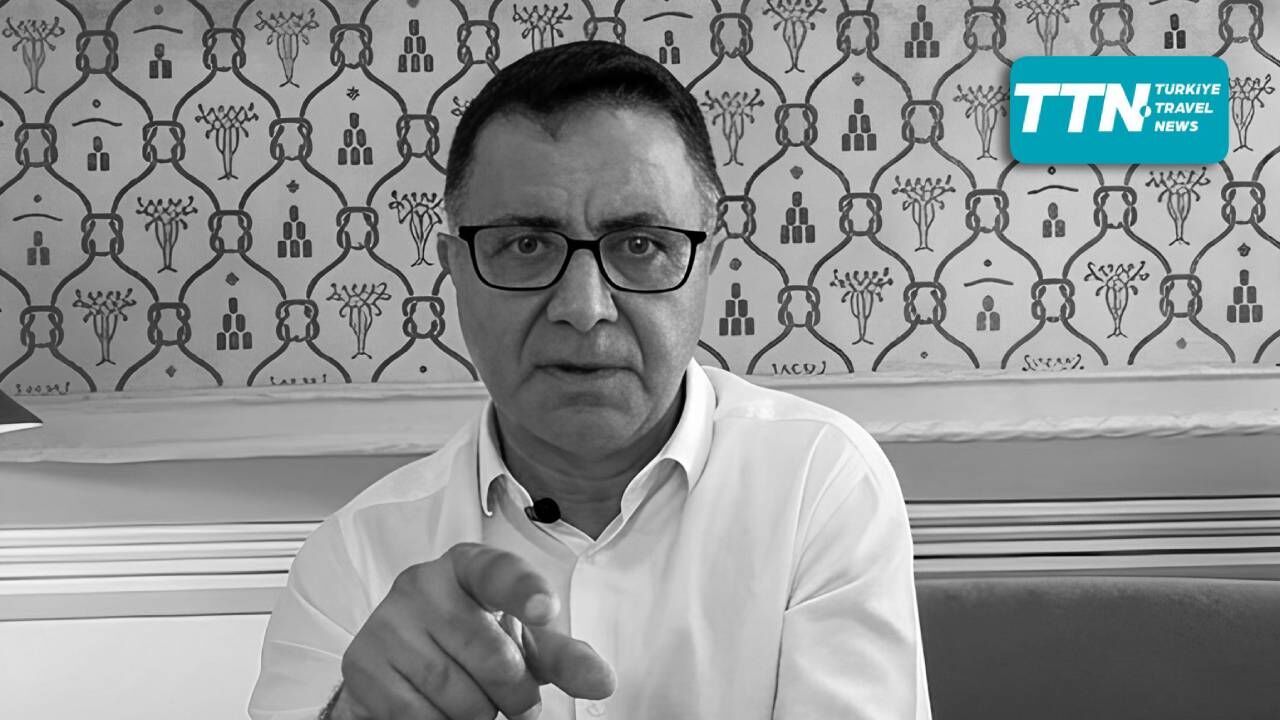
Türkiye’s tourism industry is facing growing pressure from rising costs, exchange-rate dynamics and a deteriorating international price perception, according to İskender Çayla, General Manager of Delicias Travel & Incentive and Turquia.com.
Speaking to Savaş Daş, News Director of Turizm Ekonomi, Çayla said Türkiye had faced several crises over the years, including the 2016 terrorist attacks and coup attempt, earthquakes and wars in neighbouring countries. He said the latest economic conditions were now significantly affecting the sector’s cost structure and Türkiye’s international price competitiveness.
Çayla said the widening gap between inflation and currency depreciation had pushed Türkiye’s prices significantly higher in euro terms. He added that the impact was being felt not only by travel agencies but also by hotels, guides and transportation companies, all of which were facing higher costs in Turkish lira.
“Recently, a hotel sent us a price of €60 plus VAT for two glasses of local drinks — two beers or two glasses of wine. And this was not a hotel on the Bosphorus, but on the Asian side of Istanbul. We have no way of explaining this to customers abroad.”
“Tourists are struggling to understand Türkiye’s prices”
According to Çayla, international visitors are increasingly finding Türkiye’s pricing difficult to understand.
He compared Türkiye with Spain, which he considers one of its main competitors in the Mediterranean. Çayla said Türkiye should have surpassed Spain in tourism potential within 10 years, but that this had not happened because of the problems facing the sector.
He noted that Spain had a strong first half of 2026 and continued to increase capacity despite ongoing wars. He also pointed to rising visitor numbers from South America, where some travellers are staying for periods of up to a month.
Çayla added that Spain had again become an important destination for Russian travellers able to travel in Europe, meaning that some customers Türkiye was unable to attract were now going to Spain.
High flight capacity from Spain to Türkiye
Despite substantial air capacity between Spain and Türkiye, Çayla said the number of tourists arriving in Türkiye was not matching that potential.
He noted that Turkish Airlines operates two, three or four daily flights to destinations including Bilbao, Malaga, Seville, Madrid, Barcelona and Valencia. Pegasus also flies to destinations such as Seville, Alicante, Barcelona and Madrid, while Spain-based Air Europa and Vueling operate flights to Türkiye.
Çayla said that on his most recent journey from Valencia to Istanbul, only seven passengers got off the aircraft in Istanbul.
He argued that Turkish Airlines was relying heavily on transit passengers and that only a small proportion of the available capacity was bringing tourists directly to Türkiye.
Mexico market also weakens
Çayla said a similar trend was visible in South America. Mexico, which had previously been among the top five markets for luxury travel hotels along Istanbul’s Bosphorus, had also weakened.
He said the decline was also visible among hotels in Nişantaşı and attributed it partly to Türkiye’s deteriorating price perception.
“Tourists are asking whether they are being overcharged”
Çayla stressed that he did not simply want to say that Türkiye had become expensive.
“We bring wealthy customers from abroad, particularly from the markets I mentioned. Asking €12 or €15 for a beer in Türkiye is difficult for a foreign tourist to understand. In Madrid, a coffee costs around €2, while in very high-end places it may be €3, €3.50 or €4. In Türkiye, coffee prices range from €5 to €15.”
According to Çayla, such differences can make tourists question whether they are being overcharged and can result in a loss of trust.

He said the problem was not only the overall level of prices but also a lack of consistency, making it difficult for both Turkish consumers and international visitors to understand what constitutes a normal price.
Hotel prices have not increased, Çayla says
Çayla said there was also a misconception that Turkish hotel prices had risen significantly.
He said his company brings incentive groups of between 100 and 150 people and argued that hotel prices had not increased accordingly.
“Hotels are currently losing money. Costs have increased significantly in lira terms, while revenues in foreign currency have continuously declined. There are too many hotels and fewer tourists. Therefore, even if occupancy remains the same, prices are falling and revenues cannot cover costs.”
He highlighted what he described as a growing imbalance between accommodation and food and beverage prices. For an incentive group, he said, a good-standard five-star hotel could charge around €150 per room per night, including breakfast and taxes, while a restaurant meal could cost €150 per person.
“Tourism cannot solve this on its own”
Çayla said the tourism sector could not resolve its current problems without an improvement in the Turkish economy.
He expects difficulties in Turkish tourism to continue in the short term, with economic factors among the main reasons. According to Çayla, the issue is no longer within the control of individual hotels or travel agencies.
He also compared tourism with textiles, describing both as major foreign-currency-earning sectors facing similar pressures.
“If pressure on the exchange rate continues in this way, Türkiye’s most competitive sectors, textile exports and tourism revenues, will be seriously put at risk.”
Türkiye remains below its tourism potential
Çayla said global tourism would continue to grow but argued that Türkiye was operating well below its potential.
He pointed to markets including China, India, Japan, South Korea, the Middle East, Southeast Asia, Europe, Russia and Ukraine as major sources of potential demand.
He said the tourism industry, hotels, travel agencies, guides and transportation companies, together with Turkish Airlines and public institutions, had helped build Türkiye’s tourism sector, but that the country should be in a different position given its available resources and market potential.
Sports events support tourism
Çayla also highlighted the contribution of international sporting events and concerts to tourism.
He said events such as the Champions League final, UEFA events and the Spanish Super Cup had brought significant activity to Istanbul. He also noted the contribution of major concerts, including international events held in Türkiye because of circumstances in other countries.
According to Çayla, such events should be supported rather than restricted.
He also pointed to the Basketball Development Center, built on the site of the former Abdi İpekçi Sports Hall, saying Türkiye was becoming an important global basketball hub and that sporting events generated business for hotels and local businesses.
Concert restrictions could damage Türkiye’s image
Çayla said restrictions on concerts and approaches suggesting that certain artists were “unwanted”, “harmful” or “obscene” could damage Türkiye’s image abroad.
He argued that if Türkiye did not want to create obstacles for its own tourism sector, the issue should be reconsidered, stressing that international events contribute to tourism activity and destination visibility.