
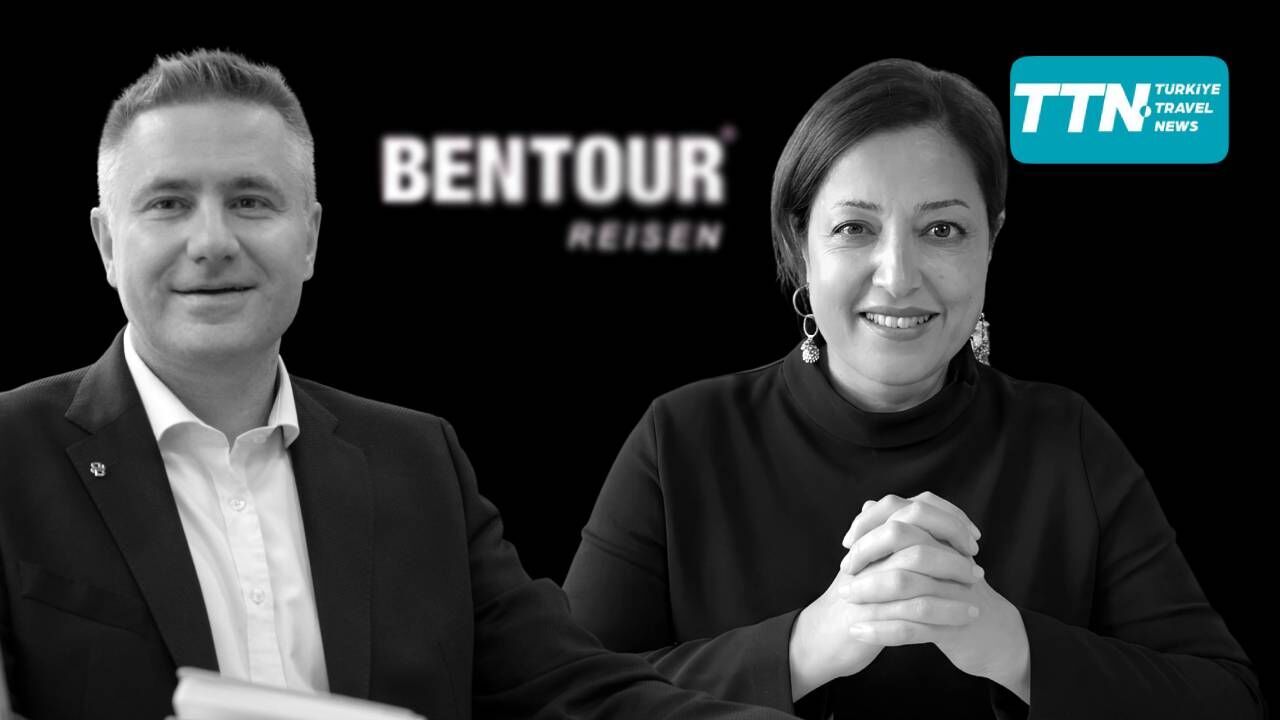
Bentour’s top executives Deniz Uğur and Songül Göktaş-Rosati describe the 2026 season as challenging but generally successful, while reporting a strong start to the 2027 early booking period.
Speaking to Turizm Ekonomi, sister portal of Türkiye Travel News, the executives said package holidays have once again demonstrated their position as a strong and secure option for holiday planning. They also noted that Türkiye maintained a strong position in key markets throughout the season and gained further momentum as the year progressed.
For 2027, Bentour is focusing on a balanced price-performance ratio, attractive early booking offers and targeted campaigns, particularly for the family segment.
“A volatile season, but a strong finish”
The 2026 season once again demonstrated how sensitive tourism demand is to economic and geopolitical developments. Strong momentum during the early booking period was followed by a temporary slowdown in spring as geopolitical uncertainties increased.
As the season progressed, however, demand picked up again, with a notable recovery particularly in last-minute bookings.
Package holidays once again demonstrated their advantages in an environment shaped by economic and geopolitical uncertainty. Predictable costs, coordinated services and reliable points of contact are expected to support continued demand for package holidays in 2027.
In Germany and other European markets where short-term bookings remain significant, customers are paying greater attention to the balance between price and performance and are making more detailed comparisons.
“The longer season is working in Türkiye’s favour”
“Germans’ passion for travel has not diminished, but the way people make their holiday decisions has changed. In this economically and geopolitically volatile period, customers are looking for more guidance and security than ever before, and package holidays provide exactly that. A package holiday combines the desire to travel with the security needed to make a reliable holiday decision.” said Deniz Uğur, CEO of Bentour Reisen AG.
Demand for traditional Mediterranean destinations remains strong during the autumn period. The longer season is working in Türkiye’s favour, although bookings are still being made closer to departure than in previous years.
Rosati: Türkiye showed notable resilience
Bentour said it views Türkiye’s performance throughout the season particularly positively. Following a temporary period of uncertainty, the destination gained significant momentum as the season progressed and retained its position among Germans’ most popular holiday destinations.
Songül Göktaş-Rosati, General Manager of Bentour Reisen Germany, highlighted Türkiye’s notable resilience during the season. She said the Turkish hotel industry had responded flexibly to market conditions.
“Especially during the last-minute period, demand increased significantly as offers once again became more attractive,” Rosati said.
“Early booking is crucial for securing the season”
Göktaş-Rosati said this resilience showed how quickly Turkish tourism businesses can adapt to changing conditions and provided important lessons for the coming season.
“Our common goal should be to create greater planning certainty through early bookings and to win guests for Türkiye in the long term. Early booking must continue to offer customers a clear and tangible advantage. If an increasingly large share of demand shifts to the last minute, planning becomes more difficult for tour operators, travel agencies and hoteliers,” she said.
“We are seeking a balance between last minute and early booking”
Rosati stressed that the aim was not to eliminate last-minute bookings completely, but to establish a balance between early bookings and last-minute demand.
“The key point is to keep price levels balanced throughout the 2027 season. A predictable pricing policy could encourage customers to book earlier again and provide greater planning security for all parties. This would create a more rational basis, both economically and for sustainable growth,” she said.
Strategic partnerships underpin growth
Bentour’s long-standing, trust-based partnerships with the Turkish hotel industry remain a key element of the company’s strategy.
The company aims to assess joint growth opportunities with strategic hotel partners and selectively develop product quality and capacity in the coming years.
“We are seen as a reliable and valuable business partner in Türkiye. This is the result of a partnership built over many years. For us, partnership means keeping our promises, acting transparently and meeting our financial obligations on time,” Uğur said.
He added that this trust enabled Bentour to grow significantly with strategic hotel partners and develop long-term perspectives together.
“Binding agreements provide planning security for both sides and allow capacity, offers and sales activities to be coordinated. Sustainable growth does not come only from increasing volumes. It emerges where business partners take a long-term view, invest together and support each other during difficult periods. Ultimately, hotels, tour operators, travel agencies and, most importantly, our shared guests benefit,” Uğur said.
Family segment offers significant potential
Rising holiday costs put considerable pressure on family budgets across Europe in 2026. This led alternative destinations with a strong price-performance balance to become more prominent in holiday decisions.
“Families have never stopped liking Türkiye. They simply have to calculate more carefully today. When a family of four realises that the holiday they had imagined has become significantly more expensive, it naturally considers alternatives. That is why we want to win this important target group back to Türkiye in a strong way,” Uğur said.
Türkiye has significant potential in this area. Its broad range of products can appeal to families with different expectations and budgets. Alongside well-known beachfront properties, hotels in second- or third-row locations that stand out through quality, service and a strong price-performance ratio also offer opportunities.
“This is exactly where our role begins”
Göktaş-Rosati said:
“As a Türkiye specialist, this is exactly where our role begins. Together with our hotel partners, we are developing different offers for families. A great holiday experience does not always require a first-line beachfront location. What matters is the overall package of quality, service and a reasonable price.”
She stressed that this did not mean positioning Türkiye as a low-cost destination, but rather highlighting quality, service, variety and a fair price-performance balance together.
At the same time, she said economic realities in important source markets needed to be taken into account when developing offers and pricing.
“Türkiye still has enormous potential, particularly in the family segment. It has lost none of its appeal. What needs to be done now is to win back families who considered or chose other destinations this season with suitable offers. If we succeed in doing this during the early booking period, we can lay the foundation for sustainable growth and greater planning security for all parties,” she said.
Travel agencies remain important as digitalisation accelerates
Distribution channels are also changing alongside developments in destinations. In 2026, short-term bookings particularly benefited from the flexibility offered by online channels. At the same time, physical travel agencies continue to play an important role in trips requiring advice.
According to Göktaş-Rosati, these developments are not contradictory. Online and physical channels will continue to develop without necessarily replacing one another. Customers are increasingly choosing the channel that offers them the greatest value in a particular situation.
Personal advice remains particularly important for families, complex trips and special requests. At the same time, the industry needs to continue developing its digital processes.
Changing booking habits and accelerating digitalisation are also being accompanied by artificial intelligence, which is expected to permanently transform the travel market.
AI will not only automate internal processes but will also influence how customers discover, compare and select travel offers.
“The biggest difference AI will make…”
Deniz Uğur said the biggest impact of AI would emerge in areas where repetitive processes are automated, allowing employees to spend more time with customers and business partners.

“At the same time, we need to learn how our products can remain visible in new AI-based search and decision-making processes. This will be an important issue for the entire industry in the future,” he said.
Outlook for 2027: Early booking, better planning and joint growth
Bentour is looking positively towards 2027. The desire to travel remains strong, while Türkiye can address different target groups and budgets through its broad product range and strong demand base.
The key issue in the coming period will be achieving an even better balance between price, service quality and capacity. Targeted initiatives aimed particularly at families could help broaden the demand base and support long-term growth.
“The key is offering the right product at the right time”
Göktaş-Rosati said there were good opportunities for 2027, but added that growth would not come solely from greater capacity or higher prices.
“The key is offering the right product at the right time and at a reasonable price. An early booking creates planning security for everyone. In return, the customer needs to receive a genuine advantage. If we succeed in this, customers, travel agencies, tour operators and, of course, hoteliers will benefit,” she said.
“We need a balanced price-performance ratio”
Deniz Uğur concluded:
“People want to travel and experience Türkiye. If we can bring families together with attractive offers suitable for early booking, we can lay the foundation for long-term growth. For this, we need a balanced price-performance ratio and strong partnerships that all parties can rely on.”