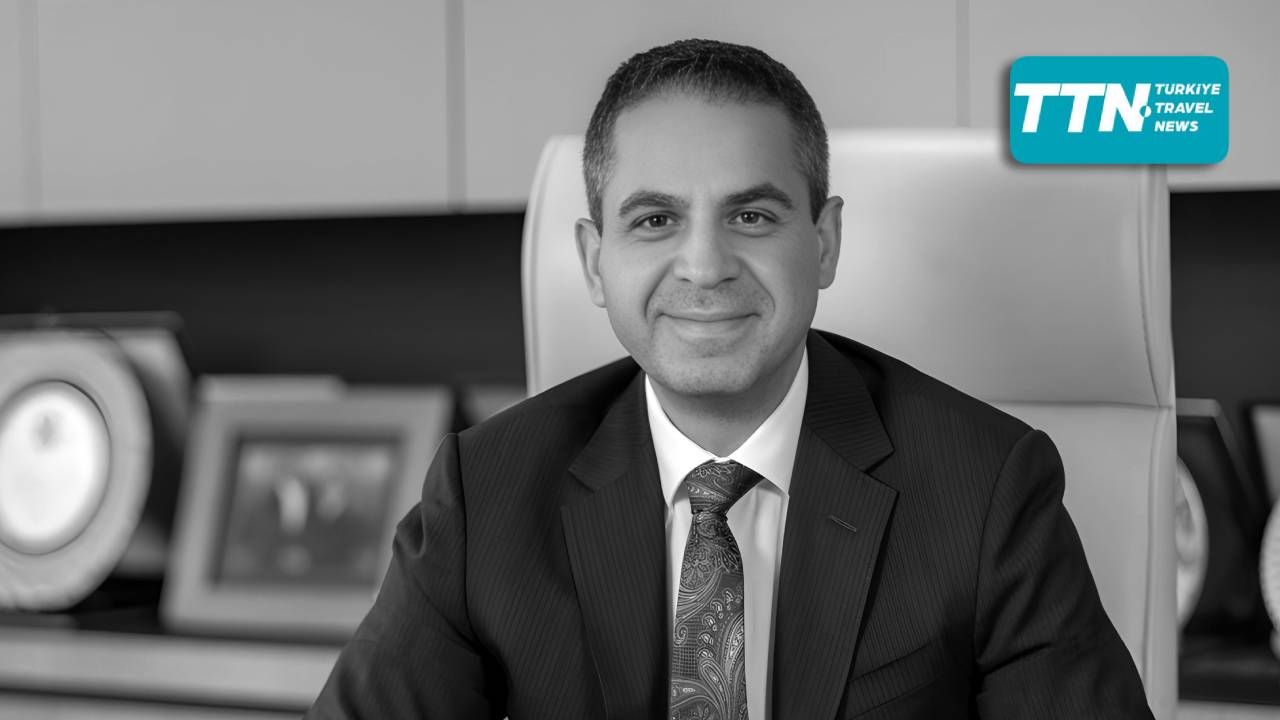
Dr. Erkan Yağcı, President of the Turkish Hoteliers Federation (TÜROFED), shared his assessment of the tourism sector’s most pressing issues with Savaş Daş, Editor-in-Chief of Turizm Ekonomi, sister B2B travel portal of Türkiye Travel News. Emphasizing that the sector is going through a challenging period economically, geopolitically, and competitively, Yağcı noted that the industry is struggling to make cost-driven price increases acceptable to the market. “Do not turn a sector that should not require incentives into one that does,” he cautioned.
“A new leap or strong growth is now difficult”
Referring to conflicts in Türkiye’s surrounding geography—including Russia–Ukraine, Israel–Palestine, and Israel–Iran—Yağcı stated that without an improvement in these conditions, achieving a new leap or meaningful growth in tourism would be difficult. He stressed that surpassing the current performance level of the sector depends on geopolitical developments in the region evolving in Türkiye’s favor.
“We lost 4.5 million visitors from Russia, Ukraine and Israel”
Yağcı underlined that Türkiye has lost around 3 million visitors from Russia, approximately 900,000 from Ukraine, and about 500,000 from Israel—totalling 4–4.5 million visitors. “Based on 2019 data, these figures represent a group that wanted or had the potential to come to Türkiye. This group included five-star, four-star, and three-star hotel guests. Their presence provided balance in the sector, encouraged operators to deploy aircraft, and acted as a crucial lever for keeping prices at certain levels. Aircraft are not filled only with five-star guests or high-income tourists; they carry passengers from various income groups, and Türkiye has a product portfolio suited to this diversity. Our existing bed capacity requires precisely this kind of market structure,” he said.
“Our tourist profile is not very willing to pay the price Türkiye deserves”
Responding to the question, “What does a global environment of declining incomes and rising prices mean for mass destinations like Türkiye?”, Yağcı said:
“There is a very mistaken perception that Türkiye is extremely expensive. Türkiye provides excellent service in the five-star segment and has not lost its price–quality advantage. Worldwide, full-service, all-inclusive five-star resorts typically start at average room rates of €1,000–1,500. In Türkiye, even approaching the €500 band is often perceived as expensive.
The problem is not that Türkiye is expensive. The unresolved issue is that our international tourist profile is still not very willing to pay the price Türkiye deserves. This may partly stem from our past strategies. Türkiye has been positioned as a destination with very high added value but low prices, and unfortunately we struggle to change this image. The same person willingly pays €700 for a five-star, bed-and-breakfast beachfront hotel in Nice, France, yet considers €500 for a fully inclusive five-star hotel in Türkiye expensive. This is fundamentally a perception and image problem.”
“They pay that price for the same product in France and Dubai”
Yağcı stressed the need for a new strategy and image management in the high-quality five-star segment to ensure visitors say, “Türkiye’s products are worth this price.” “Our prices are still very reasonable for the service we provide, but the willingness to pay remains limited. The same product commands those prices in France or Dubai, but resistance begins when it is in Türkiye. We are seen as Spain–Italy in terms of product quality, but Egypt–Tunisia in pricing. We offer very high added value, yet face difficulties in positioning Türkiye correctly. This has become particularly evident this year, especially in July and August,” he said.
“Four- and three-star hotels are trapped by exchange rates and costs”
Yağcı noted that conditions differ for four- and three-star hotels. “High inflation, a fixed exchange rate environment, and additional costs have made products more expensive. In regions like the Aegean, sharp increases in food and beverage prices—both inside hotels offering half-board, full-board or bed-and-breakfast and outside establishments—have pushed prices up. This sometimes shifts demand toward all-inclusive hotels, but that, in turn, highlights destinations like Egypt. A vicious cycle has emerged around exchange rates, inflation, and costs,” he explained.
“85% of Antalya’s tourists arrive between May and October”
Emphasizing that a country with 2 million beds must attract tourists from all segments, Yağcı said the same reality applies to Paris or Dubai. “It is not possible to attract only high-income tourists. You can bring that group mainly in July and August, when they typically travel. But there is also winter and the low season. Antalya, our top destination, receives 85% of its visitors between May and October. The same challenge persists in other months. This process must be managed with a strategy that appeals to different tourist profiles,” he said.
“Once criticized for being cheap, now accused of being expensive”
Yağcı pointed out that a sector long criticized for “selling too cheaply” is now accused of “selling too expensively.” He emphasized that most price increases in 2024 and 2025 were absorbed by rising costs. “In many cases this year, price increases did not even cover cost increases,” he said.
He added that international tour operators clearly see that Turkish hoteliers raised prices due to exchange rate and cost pressures, not sector-driven decisions. “They understand this stems from Türkiye’s political and economic conditions and respect it. However, they also note that package-tour customers are gradually struggling to afford holidays in Türkiye, as these customers largely operate within fixed budgets. Even if not stated openly, Türkiye’s long-standing market positioning plays a role here,” Yağcı said.
“If conditions do not change, 2026 will resemble 2025”
Yağcı stated that unless economic, political, and geopolitical conditions change, Türkiye’s tourism season in 2026 will likely mirror 2025. “Without a positive shift in this equation, there will be no significant change in demand or profitability in 2026 or 2027. I do not expect serious growth in tourism under these conditions,” he said.
“We must not step back from current price levels”
Highlighting the biggest current risk for the sector, Yağcı said: “The greatest danger is falling below the price levels we have achieved. Maintaining the current level would already be a success. But we must never take a step backward. Reaching this point required enormous effort, and the sector must not make such a mistake.”
“Market dynamics can sometimes change abruptly”
Addressing criticism of hoteliers who withdrew early booking discounts earlier than expected, Yağcı said: “This is a sector built through years of effort. Everyone wants to achieve the price they deserve and avoid selling at high discounts. Businesses enter the market with certain forecasts and intentions, but market dynamics can shift rapidly. We started last year strongly, but who could have predicted the Israel–Iran war by June? Pricing policies are set based on current realities and forecasts, not worst-case scenarios. When we signed contracts in September–October, the biggest risk was exchange rates, yet the war halted tourism for two to three weeks. This reality should not be overlooked when criticizing pricing decisions. Contracts are being signed now—who can predict what will happen next June?”
“A product run by 200 people in Spain needs 500–600 in Türkiye”
Yağcı noted that Türkiye has developed a perception of tourism as a constantly growing and increasingly profitable sector. “In reality, for the past two years the sector has struggled to maintain profitability, and in many businesses it has already declined. The sector is under strain, particularly from cost, exchange rate, and competition pressures. While a facility in Spain may operate with 200 employees, the same product in Türkiye runs with 500–600 people. This is the model we created. Therefore, especially in terms of taxation, an already strained sector should not be further burdened,” he said.
“Tourism must not turn into a sector that needs incentives”
Yağcı concluded by stressing that no new burdens should be imposed on the tourism sector to avoid transforming it from a “non-incentivized” sector into one that requires incentives. “In a period of high interest rates and costs, the sector must be protected with great care. Otherwise, tourism risks becoming a sector where exchange rate gaps and cost increases are even more pronounced. Tourism’s role in closing the current account deficit and generating foreign currency is clear, and these gains are not easily achieved. Introducing new taxes or additional burdens would disrupt the sector, and the consequences would be felt for the next 5–10 years,” he warned.